


|
|
Choose fault |

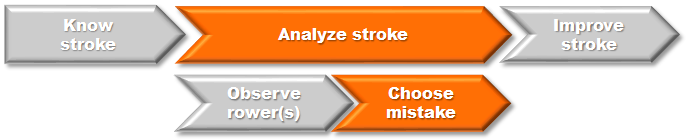
First of all, it is important to determine whether the crew or the rower is the focus point. It is therefore important to distinguish between:
| Individual faults: | faults made by individual rowers. |
| Collective faults: | faults that most of the rowers in the crew have, but which are essentially individual faults. |
| Team errors: | faults in the cooperation and interaction between team members. |
When a rower's individual technique limits him in rowing with the crew, his technique will have to be addressed first. First address the technique of individual rowers and only start with the team faults when the  J-stroke is sufficiently mastered by all rowers.
Prioritise rower faults
Looking sideways at a rower, gives a lot of information about the faults he makes. Especially when the observation points are used properly. However, the diagnosis has not yet been made: in other words, what are the most important faults and what must be tackled first.
The following applies to the prioritisation of individual and collective rowing faults
In the boat:
- First priority have those faults related to the
 Dragging stroke.
- Then faults that have to do with the rowing Rhythm.
- Finally, faults are addressed around the Catch.
In the rowing bin or on the ergometer:
- First the faults that have to do with an improper body position.
- Then the faults concerning the movement sequence of the legs, trunk and arms (see: Draw andRecovery).
Prioritise crew misstakes
Bringing the crew central to the team instruction, the priorities for the team faults are the following:
- rhythm – the basis of the draw, because without those accents in the draw not enough
- similarity – the essence of team growing, because without similarity no
- balance – the precondition for enjoyable rowing, because without balance no
- clean recovery – the precondition for learning a good rowing stroke, which in turn helps with a good rhythm!
Team faults manifest themselves in minute – but noticeable – speed differences between the rowers themselves. By rowing with motion accents, these mutual speed differences can often be eliminated.
 |
Observe rower(s) |
 |
Choose solution |
This article was translated automatically and is provided to you for free. You are most welcome to improve it!