


|
|
Motivation and focus |

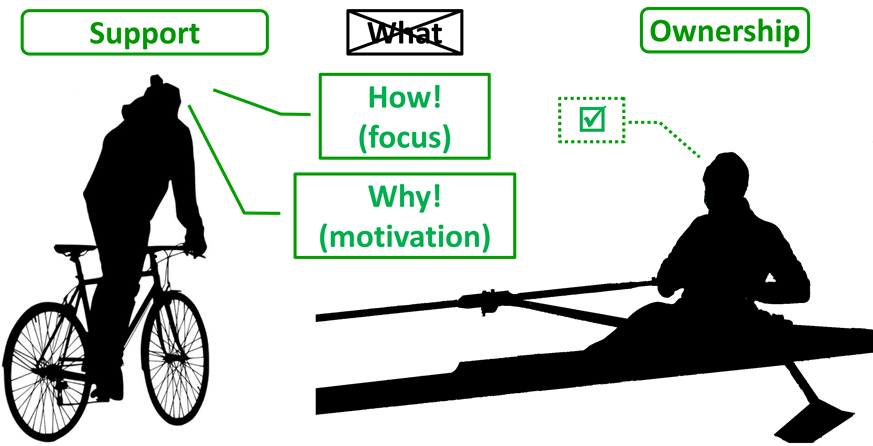
Modern approach: the coach/instructor explains how (provides focus) and why (motivates) the rower should do it.
The 'what' is omitted. The rower can keep their full attention on the execution.
Motivation (why)
Motivating is the activity where the necessity of the drill is explained to the rower. Motivation ensures that rowers are not just passively compliant, but genuinely motivated to do what the instructor/coach says. This motivation is provided by explaining why:
- continuing with the current stroke technique is risky, for example because it increases the chance of catching a crab.
- the new stroke technique generates more boat speed.
- the current stroke technique is poorly compatible with rowing in a crew, making it difficult to row in sync.
It is crucial that the instructor/coach realizes that it is not the intention behind the motivation that counts, but the degree to which the rower is convinced by it. Only when the rower is fully convinced of the drill or new stroke technique will they be motivated to do everything to execute it properly. They can and will then take ownership of their stroke movement.
Focus (how)
Focus is what the rower needs to pay attention to (intrinsic feedback) to determine for themselves whether they are making a good or bad movement. In other words: what must the rower see (visual), what must the rower hear (auditory), or what must the rower feel (kinesthetic) so that they can use (intrinsic) feedback themselves. This focus can target either the correct or the incorrect movement. When focusing on the incorrect movement, that movement should be avoided—meaning not heard, felt, or seen.
A distinction can be made between internal focus (what the body does) and external focus (the outcome of the movement). Having external focus is better than having internal focus, and having internal focus is better than having no focus at all. In that light, it is better to refer to the handle(s) rather than the hands, and to the foot stretcher rather than the feet. Thus, hand movement is internal focus, while handle movement is external focus (output).
The coach/instructor has several options to help the rower find this focus:
- think of
 Sensory cues,
- the use of Rowing rules,
- the focus leg of the stool in the three-step intervention,
- the focus in the Ergo learning process.
With these options, the rower is guided to utilize sensory perception. For example, instead of ”Keep your hands together”, the instructor asks if the rower can touch the palm of their left hand with the knuckles of their right hand during both the drive and the recover. Another example to prevent rowers from rushing the slide too early is asking: "Can you delay rushing until you feel the tendons under your knees pulling?". These are examples ofSensory cues.
 |
Providing guidance |
 |
How muscles learn and simultaneous learning |
This article was translated automatically and is provided to you for free. You are most welcome to improve it!